Taken, Broken, Shared: Catholic Witness Today, a powerful online webinar, brought together more than 3,500 registrants from across the country for a national gathering of prayer, reflection, and action, with over 1,000 attendees on Zoom live and now with over 2,700 views on YouTube. (You can read more about that incredible webinar in this press release.)
Organized in less than 36 hours by a coalition of Catholic organizations — including Catholic Climate Covenant — this call responded to an urgent question facing the Church at this moment: What does it mean to live our faith publicly when human dignity is under threat?
This gathering was not simply about responding to one event. It was about naming a deeper reality — and discerning how Catholics are called to show up with courage, care, and conviction.
What This Call Was About
This call created space for Catholics to do three essential things together: pray, listen, and act.
The evening was grounded in prayer and Ignatian reflection, reminding participants that even in moments of pain and disruption, God is still with us — forming us into people of public witness. As one opening reflection by Father Scott Santarosa, SJ, named, “Even in moments of pain and disruption, God is still forming us into people of witness who ensure dignity, justice, and hope for all.”
Participants heard directly from people living through intensified immigration enforcement and community trauma in Minnesota — voices closest to the harm. Their testimonies made clear that faithful witness begins with listening.
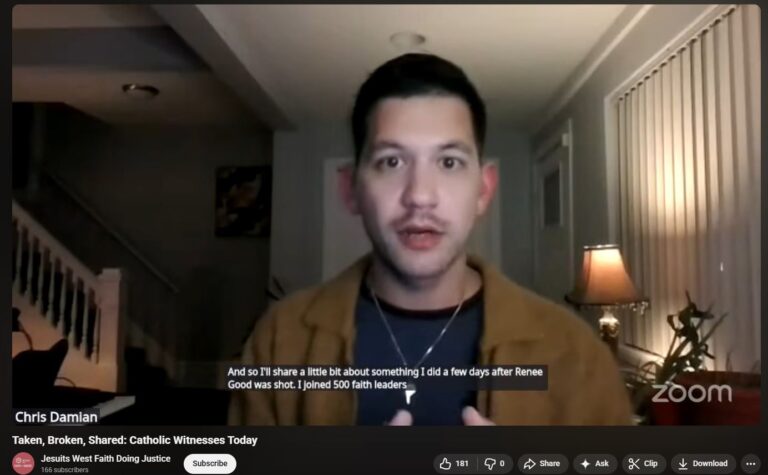
Chris Damian, a Catholic lawyer and Twin Cities resident, shared the daily reality of fear, racial profiling, and family separation, while also naming the profound solidarity growing within his community:
“I can’t tell you how overwhelming the grief, the anger, the sadness, but also the pride, connection, and gratitude have been living here in recent weeks,” he said. “If you’re living here, you’re being forced to hold a lot of things every day. I had a friend who volunteered to drive a family’s kids to school, strangers, every single day, because their parents are too afraid to leave the house, and they haven’t left their house in months. I went and showed up to pack groceries for my community, and an opportunity for connection. And then while I was there, a volunteer was on her phone, and she started sobbing, and we were all there with her in real time as kids at her school were being separated from their parents by ICE.
“I have friends whose brown kids at Catholic schools have been taunted by their peers who told them, ‘We’re going to call ICE and have your family deported.’ I had a neighbor recently, in the last few days text me telling me to be careful because ICE agents were at the store around the corner from my house. I now carry my passport like a lot of my brown friends because we know that we are people likely to be targeted, but even that is only partial protection because there are a lot of stories of ICE agents pulling brown people into cars and driving off.”
His testimony challenged narratives of disorder and instead lifted up the truth of communities responding with presence, mutual aid, and courage — armed not with violence, but with “whistles, cameras, and community.”
Kim Smick, former Executive Director of Leadership Roundtable, who was raised in Minneapolis, reflected on the collapse of accountability and the moral clarity of this moment. Drawing on her Benedictine formation, she contrasted the rhythms of prayer and stability with the terror unfolding in neighborhoods:
“It is the residents — the immigrants, the citizens, the neighbors — who are standing in the gap,” she said. “I walked in the protest last weekend, nearly a hundred thousand people marching in love and anger and peace in Minneapolis. And I cried icicles, literally, not because I was sad, but because I was continuously moved by my fellow Minnesotans who were helping keep me warm. The sacrifice, the strength, the anger, the science, the creativity, the sense of humor. Thank goodness that they were there, the absolute resolve to protect each other.”
She named the exhaustion, fear, and grief people are carrying, while also pointing to the deep resolve and creativity of Minnesotans who continue to show up for one another.
Emilia Gonzalez Avalos, Executive Director of Unidos Minnesota, rooted the crisis in Catholic history and teaching. She reminded participants that the Church itself was built by immigrants and warned against the cost of silence:
“When we deny dignity to immigrant families, we do not just fail them — we weaken the common good.”
She named this moment as a redemption opportunity for the Church: a chance to move beyond past failures and live out solidarity not just in words, but in action.
Why This Moment Matters
Faith leaders from across the Church helped name why this moment demands a response rooted in both prayer and public witness.
Sr. Carol Zinn, SSJ, Executive Director of the Leadership Conference of Women Religious, invited participants to reflect on the meaning of now — not only as the present moment, but as what we now know:
“This did not just happen. We have seen this coming. And now that we know, what does faith ask us to become?”
She named this time as a “moral convulsion,” reminding participants that such moments in history require deeper faith, long-term commitment, and a willingness to walk together for the marathon ahead.
Bishop Brendan Cahill, Chair of the USCCB Migration Committee, grounded his reflection in Hebrews 13: “Do not neglect to show hospitality to strangers. By doing so, some have entertained angels without knowing it.”
He reminded participants that welcoming the stranger is not optional — it is a core expression of God’s tenderness made visible through our actions.
Bishop Oscar Cantú shared personally about the fear he has felt as the son of immigrants, even as a U.S. citizen, and emphasized that prayer must lead to advocacy: “This anger and fear and grief have to be focused. It has to be directed.”
He called for renewed commitment to comprehensive immigration reform alongside immediate solidarity with immigrant families.
Bishop Joseph Tyson reminded the gathering that the word martyr means witness: “Not all of us are called to be martyrs, but I think we are all called to be witnesses.”
He urged Catholics to resist fear, reject division, and live the works of mercy joyfully and publicly — especially in communities beyond the spotlight.
Together, these reflections named a shared truth: faith that remains private in times of injustice is not faithful at all.
What Faithful Witness Looks Like in Practice
The gathering also lifted up concrete examples of Catholics already living this call.
Jennifer Kleinjung of the Dorothea Project shared how Catholic women in Minneapolis have organized rosaries, vigils, and accompaniment for detained mothers, reminding participants that “doing the next right thing is a faithful step forward.”
Ellie Hidalgo of Discerning Deacons described Catholic Masses, processions, and prayer outside immigration courts in Miami, showing young people that the Church stands with families in fear — and that public witness can grow quickly when rooted in faith.
These stories made clear that faithful witness is not about perfection or scale — it is about presence, courage, and inviting one more person to walk alongside us.
What You Can Do Next
This gathering was a call not only to reflection, but to action.
Here are concrete ways Catholics can continue to live faithful witness:
1. Advocate for human dignity
- Contact your U.S. Senators and urge them to oppose increased ICE and DHS funding without safeguards for accountability, due process, and family unity
- Sign NETWORK’s Action Alert and, for Catholic religious leaders, add your name to the letter to Congress
2. Join the Season of Faithful Witness
- Commit to organizing or participating in a public expression of Catholic faith — such as a vigil, Mass, procession, Stations of the Cross, or prayer service — between Ash Wednesday and Corpus Christi
- Join a Season of Faithful Witness Orientation call on Tuesday 2/10 at 8pm ET OR Thursday 2/12 at 3pm ET You can learn more about the Season of Faithful Witness here.
3. Support communities on the ground
- Support and accompany organizations responding directly to this moment, including:
- Minnesota Freedom Fund
- Stand with Minnesota
- Centro de Trabajadores Unidos en La Lucha
- Church of the Ascension (Minneapolis) Emergency Relief Fund
- ISAIAH’s Palm Sunday Pathway (for those in Minnesota)
- Laudato Si’ Movement chapter in Minnesota’s sign on letter (for those in Minnesota)
4. Stay rooted in prayer and formation
- Participate in prayer services and resources shared by Pax Christi USA and partner organizations
This gathering revealed something powerful: many Catholics are longing for spaces that hold grief and hope together, that connect prayer to action, and that make public witness possible.
Our tradition calls us not to turn away, but to show up — taken, broken, and shared — for the life of the world.