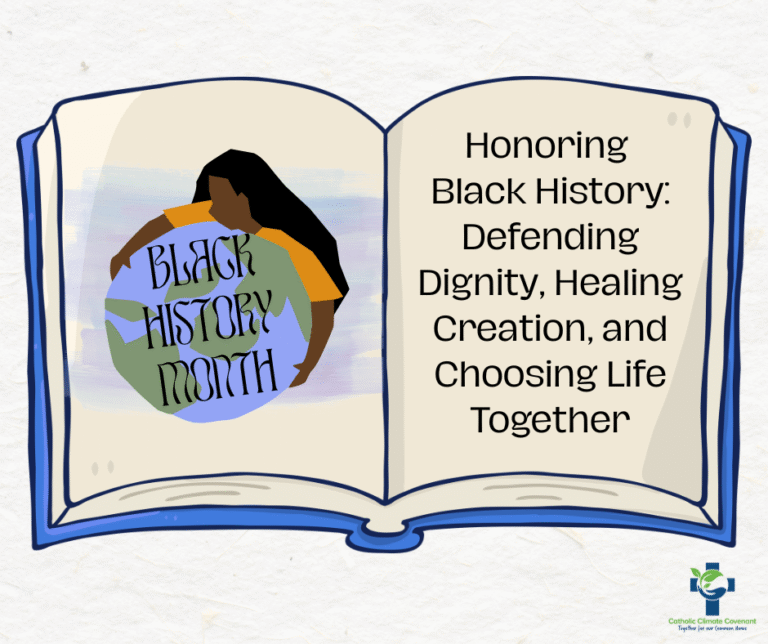
During Black History Month, we pause to remember, grieve, celebrate, and recommit ourselves to the work of justice. This month invites us not only to recall the extraordinary contributions of Black leaders, saints, and communities, but also to confront the enduring systems of violence, exclusion, and environmental harm that continue to deny Black Americans their full human dignity.
Just weeks ago, Catholic Climate Covenant reaffirmed a foundational truth of our faith: every human person bears inherent and inviolable dignity. We named our concern for immigrants, for communities of color, and for all those whose lives are treated as expendable by systems of power. Black History Month calls us deeper into that same moral conviction.
The histories of racism, enslavement, segregation, redlining, mass incarceration, and environmental injustice are not separate chapters from the climate crisis. They are part of the same story. Communities that have been historically devalued are the very communities most exposed to pollution, extreme heat, unsafe water, and climate-driven displacement. As Pope Francis reminds us, all is connected.
To honor Black history faithfully is not only to celebrate resilience and faith, but to confront the ongoing realities that make Black lives more vulnerable — to violence, to poverty, and to ecological harm. When any community is treated as disposable, our common home suffers alongside our common humanity.
The Gospel leaves us no room for neutrality. Jesus identifies Himself with those who are hungry, imprisoned, targeted, and pushed to the margins. In Matthew 25, He does not ask what policies we preferred, but whether we recognized Him in the lives of the most vulnerable.
Black History Month, then, is a call to conversion. It asks us to examine how racism distorts our relationships with one another, with creation, and with God — and to choose a different way forward rooted in justice, solidarity, and hope.
As Catholics, we know the importance of ora — prayer — and labora — work. So what can we do in our work and prayer lives to remember our brothers and sisters of color?
Black Christian Witnesses and Saints
As Catholics, we look to the communion of saints and holy witnesses who show us what faithful resistance and radical love look like, and ask them to intercede on our behalf:
- Servant of God Sister Thea Bowman, FSPA: A prophetic voice for racial justice, cultural inclusion, and authentic Catholic witness, calling the Church to confront racism with joy, truth, and love.
- Venerable Henriette Delille: Founder of the Sisters of the Holy Family in New Orleans, who served enslaved and free Black people despite laws forbidding such ministry.
- Venerable Pierre Toussaint: A formerly enslaved man whose life of generosity, charity, and quiet resistance embodied Gospel love in action.
- Servant of God Julia Greeley: Known as Denver’s “Angel of Charity,” she served the poor with profound humility, especially those who were overlooked or forgotten.
- St. Martin de Porres: Patron of social justice and racial harmony, whose care for the sick, the poor, and even animals reminds us that compassion knows no boundaries.
- Hazel Johnson: Known as the mother of environmental justice, she advocated for the well-being of her community in Altgeld Gardens on the southside of Chicago. She was also a devout Catholic who worked in her local parish.
- The Rev. Dr. Martin Luther King Jr.: Honored as a Christian witness whose theology of nonviolence, beloved community, and moral courage continues to challenge Christians to confront injustice without surrendering hope.
- Cardinal Wilton Gregory: He was the first African American cardinal. He was also the first cardinal to greenlight a Laudato Si’ Action Plan in 2015 (in Atlanta) and linking environmental justice and Catholic Social Teaching.
These witnesses remind us that holiness is not passive. It is courageous, inconvenient, and deeply rooted in love.
Prayers
A Prayer for Dignity, Justice, and Healing from Catholic Climate Covenant
God of our ancestors,
God of the enslaved and the free,
God who hears the cry of Your people,
We come before You with gratitude
for the faith, courage, and perseverance
of Black communities who have trusted You
even in the face of violence, exclusion, and loss.
We thank You for the witnesses
who proclaimed the Gospel through action,
who defended life when it was threatened,
and who believed that love is stronger than death.
Forgive us, O Lord,
for the times we have been silent
when Your children were harmed,
for the ways we have benefited
from systems that deny dignity to others,
and for failing to see Your face
in those pushed to the margins.
Heal the wounds of racism
that scar our communities and our Church.
Soften hearts hardened by fear.
Strengthen all who labor for justice,
especially those protecting creation
and defending communities most harmed
by environmental degradation.
Teach us to welcome the stranger,
to protect the vulnerable,
to honor Black lives as sacred,
and to live as faithful stewards
of our common home.
May our prayer move us to action,
our faith move us to courage,
and our love reflect Your own.
We ask this through Christ our Lord.
Amen.
Resources and organizations
There are several resources you can use to further your knowledge and support other organizations and the work they do. Read more below.
Religious
Each year, the United States Conference of Catholic Bishops (USCCB) celebrates a National Day of Prayer for the African American and African Family, while supporting dozens of related organizations around the world. You can find a list of those resources here.
Youth Leadership
If you’re a Black youth, consider applying for the Young Black Climate Leaders Youth Futures Fund. The YBCL Youth Futures Fund supports young Black people who are taking the initiative to dismantle the delusion of white supremacy, its disproportionate impacts on Black communities and communities of color in general, and disrupt climate chaos.
The fund will support a new generation of Black climate leaders to advance work and initiatives at the intersection of racial and climate justice by supporting the power of leaders who advocate for community participation and the reclamation of Indigenous ecological wisdom and practices across the African diaspora. Learn more and apply here.
Volunteer-based
There are also several Black faith organizations working on these important issues, Catholic and otherwise, if you’d like to connect with one in your area or support their work:
- Rise St. James (Louisiana): A faith-based grassroots environmental justice group rooted in a predominantly Black Catholic community near New Orleans, founded to protect local communities from industrial pollution and environmental harms. They are also a partner of the Covenant. Learn more.
- Green the Church: An organization that works at the intersection of faith, sustainability, and environmental justice, originally rooted in the Black church community. It helps congregations “green” their ministries and addresses how environmental issues intersect with racial and economic justice — a great example of Black faith leadership in ecological care. Learn more.
- National Black Church Initiative – Environmental Justice Initiative: A coalition of Black churches across multiple denominations that is mobilizing congregations and faith leaders to educate, advocate, and act on climate and environmental justice, connecting racial justice with stewardship of creation. Learn more.
- Climate Revival (Black Church Climate Action): A movement rooted in the Black church tradition that calls congregations to lead on climate justice, using music, spirituality, and storytelling as tools to mobilize faith communities for environmental action. Learn more.
- The Black Church Center for Justice & Equality (Environmental Justice Program): Works with Black clergy and congregations, especially in the Philadelphia area, training pastors and faith leaders to advocate for environmental justice, clean energy, and climate policies from the pulpit to the public square. Learn more.
Take Action
Black History Month invites us not only to reflect, but to respond.
As Individuals
- Examine how racism and environmental injustice intersect in your own community. Learn whose neighborhoods bear the greatest environmental burdens.
- Pray intentionally for Black leaders, organizers, clergy, and communities working for justice and healing.
- Support Black-led environmental and climate justice organizations.
As Parishes and Faith Communities
- Host a prayer service or educational event on racial and environmental justice during Black History Month.
- Invite Black Catholic voices to speak, preach, or lead reflection.
- Audit parish practices to ensure they reflect inclusion, equity, and care for creation.
As Advocates
- Support policies that protect communities of color from environmental harm and climate displacement.
- Advocate for accountability, due process, and nonviolent approaches to public safety.
- Speak out when human dignity is violated — whether through racialized violence, environmental exploitation, or unjust immigration practices.
As Stewards of Creation
- Recognize that caring for creation is inseparable from caring for people.
- Prioritize climate solutions that center those most impacted by pollution and climate change.
- Commit to sustainable practices that reduce harm to vulnerable communities.
Black History Month is not a detour from Catholic Climate Covenant’s mission — it is a deepening of it. To defend creation is to defend human dignity. To honor Black lives is to honor the God who created them. To remain silent is to accept a world that treats both people and the planet as disposable.
May this month strengthen our resolve to welcome the stranger, protect the vulnerable, confront injustice, and care for our common home — knowing that in doing so, we encounter Christ Himself.
The time for ora et labora — prayer and action — is now.