
May 26, 2026
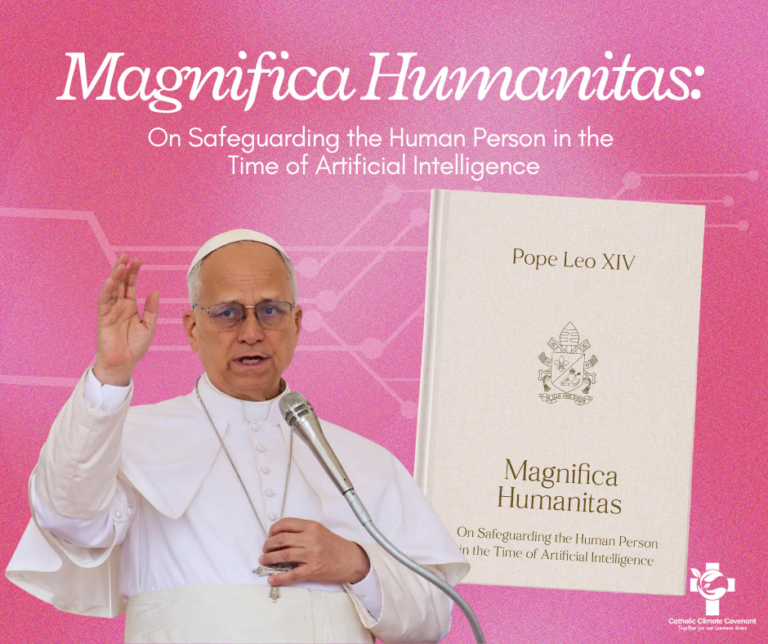
Catholic Climate Covenant and Laudato Si’ Movement – North America applaud Pope Leo XIV’s first encyclical, Magnifica Humanitas, as an important and urgently needed contribution to the global and ethical conversation about artificial intelligence (A.I.), human dignity, and building a humanity-centric future.
Magnifica Humanitas builds on all of the Church’s Social Doctrine, and in particular, two of Pope Francis’ influential encyclicals, Laudato Si’ (on the environment) and Fratelli Tutti (on human flourishing in a global community). It roots integral ecology as a core lens through which to discern God’s hope for us in the current realities we live, seeing the crises of the environment and the crises of social/human relationships as one complex and integrated crisis. The common denominator in this complexity is that humans, not machines, are made in the image and likeness of our creator God.
At a time when rapidly developing technologies are reshaping every aspect of society, Pope Leo XIV offers a clear moral reminder that technology must serve the common good, protect human dignity, and respect God’s creation. Magnifica Humanitas challenges all people of goodwill to consider not only what artificial intelligence can do, but what kind of world it is helping to create. The human is irreplaceable, and the human in community must drive technology to serve the common good, not just the wealthy and connected.
We are especially grateful that Pope Leo addresses the environmental consequences of the expanding digital economy. As A.I. systems grow and data centers multiply across the globe, their enormous demands for energy, water, and natural resources carry profound implications for our common home. These significant environmental costs are too often ignored in public discussions surrounding innovation and economic growth. And, as is always the case, it is the poor and the marginalized who have to pay the highest price, whether that’s unaffordable utility costs to subsidize energy consumption powering A.I. data centers, or contaminated air and water, causing significant health impacts for entire communities, or destroyed ecosystems.
The encyclical rightly insists that each of us use intentional and moral discernment in the creation and implementation of technology, in order to ensure that “innovation genuinely serve integral human development” (181). Communities already facing poverty, pollution, displacement, and climate impacts are shouldering the hidden environmental and social burdens tied to advancing technologies which prioritize profit and efficiency above human dignity, including extractive industries, infrastructure, and unchecked development.
Our task today is not only ethical or technical. It is ecological in the deepest sense, for it concerns a new dimension of our common home. AI is already an environment in which we are immersed, as well as a force with which we must engage. For this reason, merely regulating it is insufficient; it must be disarmed, welcoming, and accessible (110).
Catholic Social Teaching has long affirmed that human life, economic systems, and care for creation are inseparable. Magnifica Humanitas continues that tradition by asking whether our development and use of technologies is advancing solidarity, justice, truth, and authentic human flourishing, or only deepening inequality and weakening our relationships with one another and the natural world.
Pope Leo XIV also insists that everyone holds responsibility, even if differentiated, in discerning the answers to these questions. Questions surrounding artificial intelligence are not only technical or economic, but they are also fundamentally moral and spiritual questions about what it means to be human and how we live responsibly within creation.
Leadership from both Catholic Climate Covenant and Laudato Si’ Movement – North America praised the encyclical.
“The moral implications of AI are so profound that Pope Leo calls for it to be ‘disarmed’ in much the same way as Pacem in Terris called for the abolition of nuclear weapons. It is urgent that we begin a sustained dialogue about the direction of AI—that it serves humanity, not itself,” said Dan Misleh, executive director of Catholic Climate Covenant. “Technology can promote human flourishing, or it can devolve into a soul-crushing tool that leaves us enslaved to its power.”
“This encyclical is a powerful call to discernment and reflection from every person as Pope Leo XIV asks that we consider what kind of world we are called to build, and assures us that working for the upholding of inherent human dignity and our ‘situated anthropocentrism’ in God’s creation is the work of following the Gospel,” reflects Anna Johnson, North America Director for the Laudato Si Movement. “He re-centers us towards God and community, and reminds us of our irreplaceable call as a part of God’s magnificent humanity, in protecting all of creation.”
Catholic Climate Covenant and Laudato Si’ Movement – North America join Pope Leo XIV in calling for all people of goodwill to come together in building a future in which innovation is guided by wisdom, accountability, and care for the vulnerable through our individual, business, and communal actions, whether that be how we use technological tools, how we commit to orienting our shared moral compass in our workplaces and communities, or how we advocate for a just and liveable present and future. As people of faith, we believe technological advancement must never come at the expense of human dignity or the health of our planet.
We pray that Magnifica Humanitas will inspire people in governments, businesses, faith communities, and families to build this civilization of love.